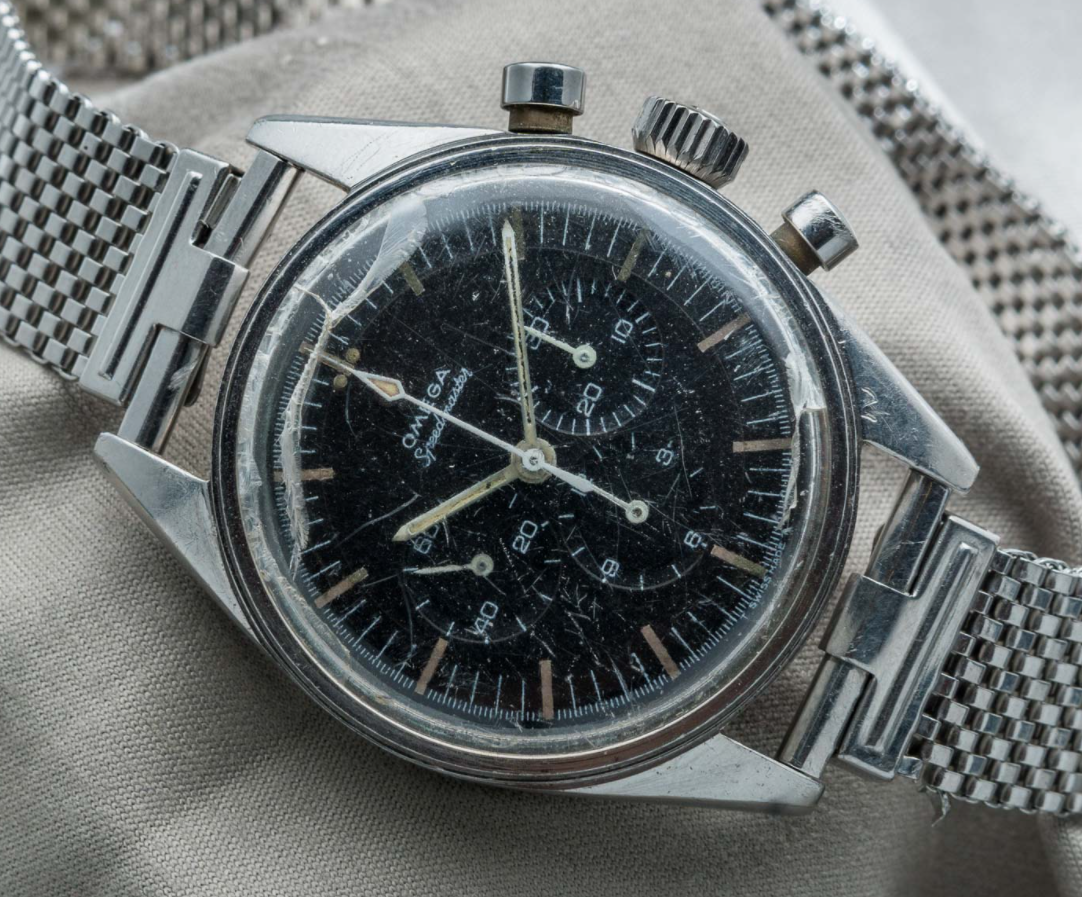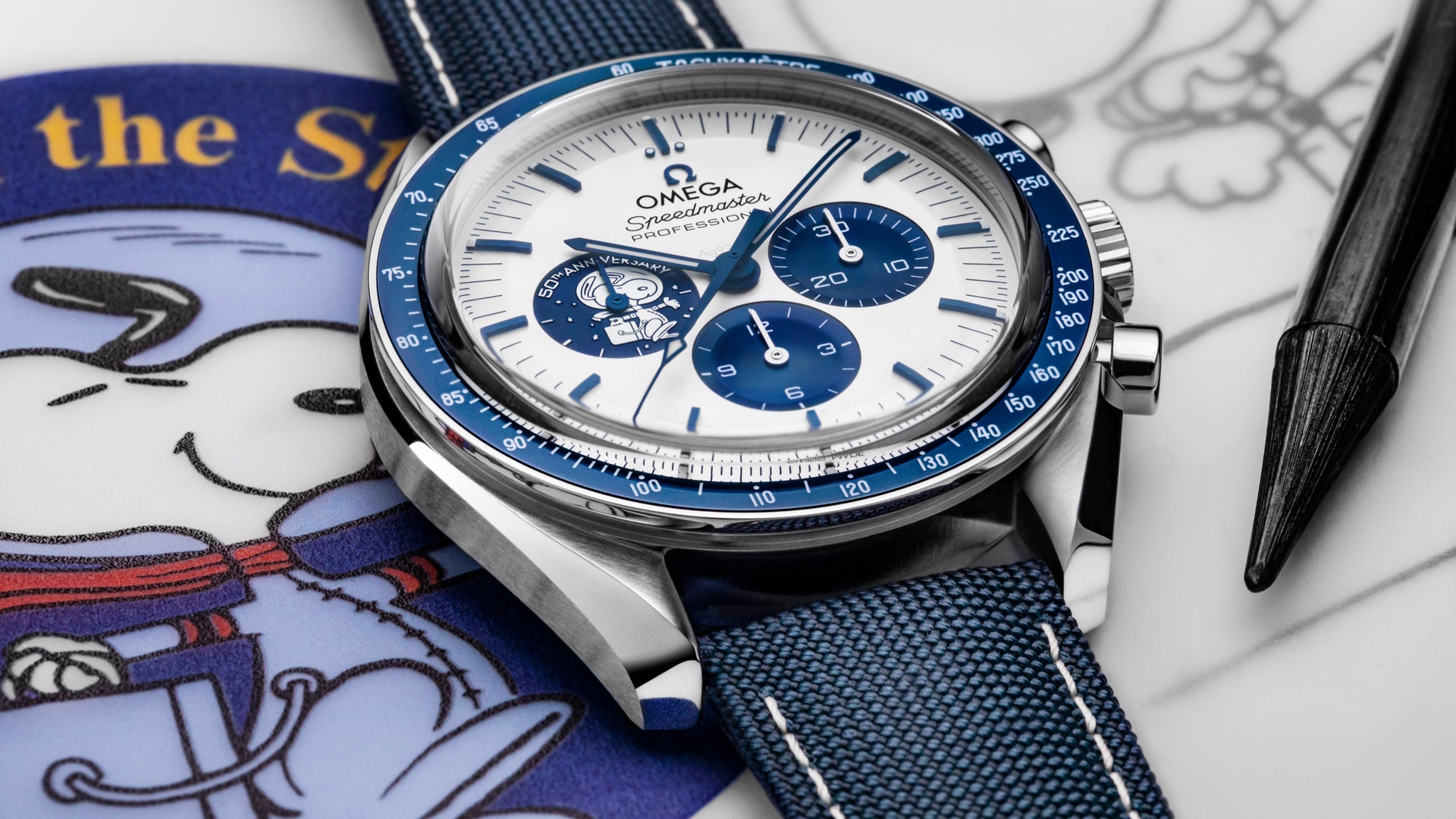
The story of the Omega Speedmaster and the enigmatic Alaska Project begins not with the Moon landing but seven years earlier, long before Neil Armstrong uttered his legendary “one small step” phrase. In 1962, during the Mercury-Atlas 8 mission, astronaut Wally Schirra found himself orbiting Earth with his Omega Speedmaster 2998 strapped to his wrist. Following the successful splashdown, at a time when mass media was flooded with photographs of astronauts and rockets, one image from Schirra’s mission made its way across the Atlantic and onto the desks of Omega executives in Switzerland — Schirra, suspended in weightlessness, wearing his Speedmaster.
Until that moment, no one in Biel truly realized that this chronograph, originally engineered for timing events (of all sorts), had already left Earth and proven itself in the harsh environment of space. Once they did, the Omega execs reacted immediately and with purpose.
NASA needs a watch

By 1964, Omega, Rolex, and Longines-Wittnauer had become the three remaining brands whose chronographs would undergo NASA’s notoriously brutal qualification program. To earn the coveted status “Flight-qualified by NASA for all manned space missions,” top fake Omega watches had to survive a sequence of extreme, punishing tests designed to simulate the absolute worst conditions a timepiece might encounter in spaceflight. NASA devised 11 separate trials.
Achieving NASA spec
- High-temperature test: 70 °C for 48 hours and then 93 °C for 30 minutes in a partial vacuum.
- Low-temperature test: -18 °C for four hours.
- Vacuum test: heated in a vacuum chamber and cooled to -18 °C for several cycles.
- Humidity test: ten 24-hour cycles in >95% humidity with temperatures ranging from 25 °C to 70 °C.
- Corrosion test: an atmosphere of oxygen at 70 °C for 48 hours.
- Shock-resistance test: six shocks at 40 g in six different directions.
- Acceleration test: progressive acceleration to 7.25 g for about five minutes and then to 16 g for 30 seconds on three axes.
- Low-pressure test: pressure of 10.6 atmospheres at 70 °C for 90 minutes and then at 93 °C for 30 minutes.
- High-pressure test: air pressure of 1.6 atmospheres for 60 minutes.
- Vibration test: random vibrations on three axes between five and 2,000 Hz with an acceleration of 8.8 g.
- Sound test: 130 decibels at frequencies from 40 to 10,000 Hz for 30 minutes.
Passing this gauntlet meant that the watch could theoretically survive forces up to five times greater than those encountered during the most extreme emergency scenarios in crewed spaceflight, such as a ballistic emergency reentry of a Soyuz capsule. In the end, only one watch emerged victorious — the Omega Speedmaster ref. 105.003. It became the sole chronograph to pass NASA’s torture program without compromise, earning full flight qualification and cementing its role as the official cheap replica Omega watches for Gemini and Apollo astronauts. On June 1st, 1965, the Speedmaster received the official qualification to be used in space during EVA.
Flight-qualified
The 1968 launch of Apollo 7 marked NASA’s transition from near-Earth orbital missions to the bold lunar program that would eventually culminate in the first Moon landing. And with that transition came a host of new technical challenges. For example, during the roughly four-day journey covering approximately 386,000 kilometers to the Moon, the exterior of the spacecraft could heat to nearly 200 °C on the sunlit side, while dropping to -148 °C on the dark side. A thermal differential approaching 350 °C created enormous structural stress on the capsule’s outer shell and its sensitive onboard equipment. To combat this, engineers implemented what became known as Passive Thermal Control — more colloquially, the “barbecue roll.” Picture a rotisserie spit turning slowly over a flame. The spacecraft gently rotated along its central axis to distribute heat evenly across its surface, preventing catastrophic thermal concentration.
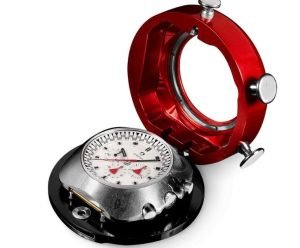
By this stage, the Omega Speedmaster had already secured its position as NASA’s official EVA (Extra Vehicular Activity) replica Omega watches UK, and Omega quietly began developing a successor — a specialized instrument designed exclusively for NASA’s future missions, capable of correcting every shortcoming identified in the existing Speedmaster. This covert initiative received the code name Alaska Project.
The Speedmaster Alaska Project

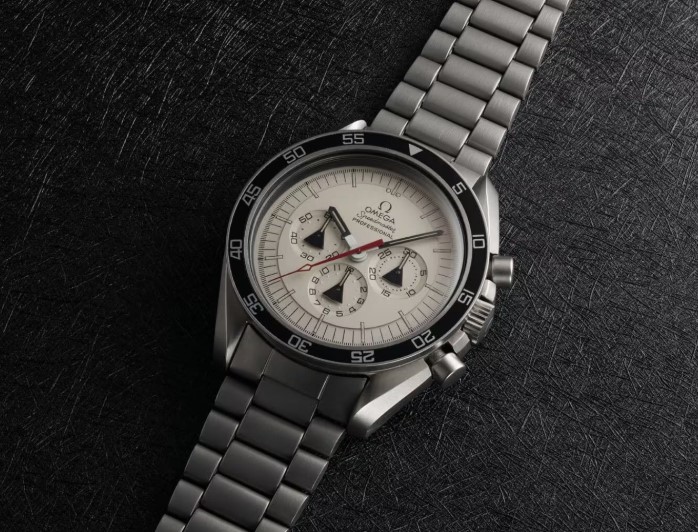
The “Alaska” name had nothing to do with the US state. Instead, Omega deliberately chose the misleading code name to throw off competing brands and obscure the project’s true purpose. The initial prototype, Alaska I (ref. 5-003), emerged in 1969. Fascinatingly, it was not technically a Speedmaster in terms of case design, nor did it even bear the name, but it shared the same beating heart — the legendary caliber 861.
The Speedmaster DNA was still recognizable through its triple-register chronograph layout and baton-style hands. However, the case was radically different. Crafted from titanium, it had an asymmetrical cushion shape, a 44mm diameter, curved pushers, and a deeply recessed crown that stayed shielded from impact when not in use. Instead of a tachymeter bezel, which was useless in space, the Alaska I employed an internal chapter ring with fine subdivisions for high-precision timing. The chronograph hands were rendered in bright red, while the sub-dial hands were sculpted in the silhouette of the Mercury and Gemini capsules. This was a functional decision reflecting astronaut demands for maximum legibility under poor-visibility conditions, not a mere stylistic flourish.
Thoughts on the Alaska Speedmaster
From a personal standpoint, I’m probably one of the most biased people to evaluate Speedmasters. There’s hardly a version I genuinely dislike (with the notable exception of the Apollo XVII 40th Anniversary). Still, wearing the Alaska Project is a unique pleasure. It feels like a Speedmaster, yet looks like nothing else in the lineup. When it debuted in 2008, it wasn’t met with the enthusiasm it enjoys today; it often sat in display windows longer than expected, priced only slightly above the standard perfect copy Omega watches.
I vividly recall the market in 2013 while hunting for my first Speedmaster; both the regular Moonwatch and the Alaska Project were hovering around €3,000 on the secondary market for a full set. Today, the narrative has flipped entirely: the Alaska Project routinely surpasses €15,000, with mint examples commanding significantly higher prices.
Wearing the Speedmaster Alaska Project
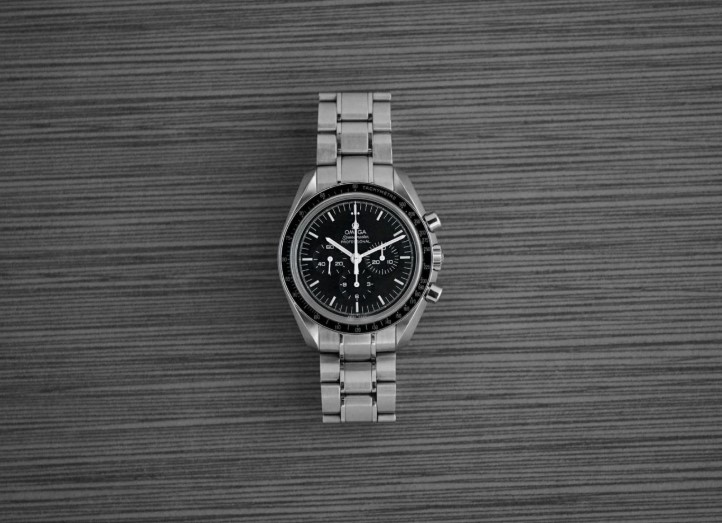
On the wrist, the Alaska Project wears exactly like a Speedmaster Professional, with the same footprint and ergonomics, but the dial transforms the experience. On paper, a white dial with black hands should deliver perfect contrast and superb legibility; in reality, once the Sun begins to dip below the horizon, the classic black-dial Moonwatch pulls ahead.
Curiously, although the lume formula is the same, the Super-LumiNova on white appears brighter, likely because the green glow contrasts more sharply with the bright background. Strap versatility, however, is where the Alaska Project encounters its limitations. The Speedmaster Professional is famously a “strap monster, ” capable of pairing with virtually any material or color — steel, rubber, leather, NATO, canvas, you name it.
One might assume that the combination of white and red would be even more flexible, but in practice, it is surprisingly restrictive. Neutral tones — black, gray, navy — look exceptional, emphasizing the technical nature of the watch, while warmer hues like light brown tend to clash and diminish the aesthetic harmony.
Final thoughts
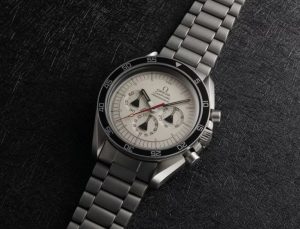
Despite these quirks, the Alaska Project remains one of the most original and compelling Speedmasters ever created, boasting a backstory that is rich and captivating enough to intrigue even the most discerning AAA+ replica Omega watches enthusiast. With its thermal shield, its NASA-inspired design, and the included NATO straps made from materials reminiscent of astronaut suit fabrics, the complete set is more than justified in its cult status. And if I had to choose just one chronograph to accompany my black vulgaris Omega Speedmaster Professional, there’s no question that it would be the Alaska Project.